
Having spent over two decades in the IT industry—starting in the trenches writing code, moving up through project management, product design, and sales, before running my own business for over ten years—I’ve seen countless hypes come and go. Every few years, the tech circle crowns a new god. The latest frenzy revolves around AI Agents and coding assistants, with Claude Code currently sitting on the throne.
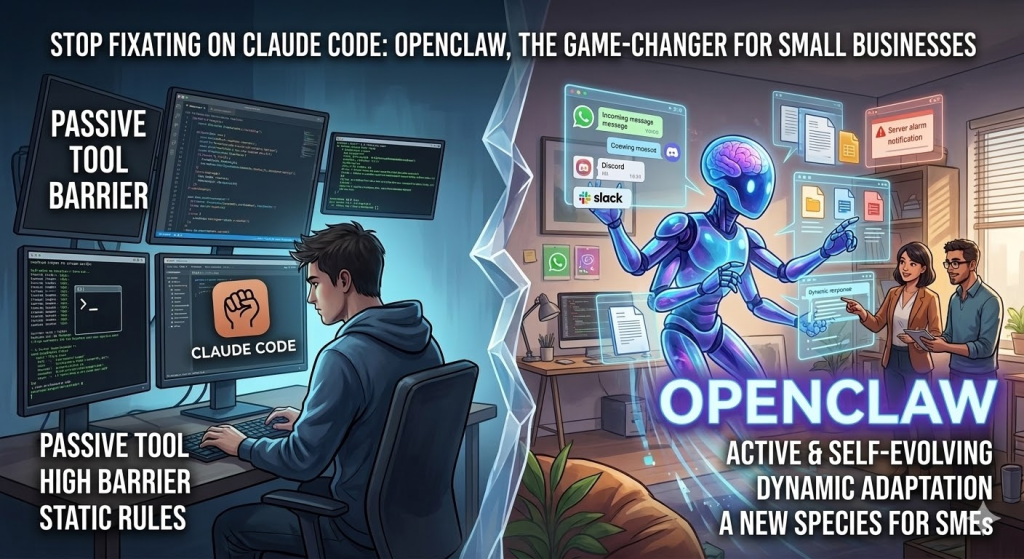
If you browse tech forums, X (Twitter), or GitHub, top-tier geeks and big-tech elites are partying as if Claude Code is the final puzzle piece to AGI (Artificial General Intelligence).
But let me give you the honest truth from the trenches: For the vast majority of small and medium-sized enterprises (SMEs), startup studios, and everyday people looking to boost efficiency, Claude Code is simply not for you. The real “new species” capable of transforming your business operations—the one willing to do the heavy lifting—is OpenClaw, a project currently making massive, controversial waves in the open-source community.
Why do I say this? Let’s skip the high-sounding buzzwords and break this down from the fundamental logic of business and technology.
Chapter 1: The Elitism of Claude Code and the “Insulator” for Everyday Users
When comparing AI tools, people love to list specs: context window size, coding error rates, number of languages supported. This is purely a “parameter-obsessed” mindset.
We need to look at the product DNA.
What is Claude Code’s DNA? It is a divine weapon forged for top-tier programmers. It is firmly locked inside the Terminal and the IDE (Integrated Development Environment). Its operational model is strictly “command-and-response”: you type a highly specialized command, it scans your entire codebase, finds bugs, refactors code, or writes test cases. Once the job is done, it shuts up and sits there, waiting for your next god-level instruction.
What is this? This is a “passive, high-end tool.”
For an average user, or a business owner trying to solve operational bottlenecks, Claude Code is highly unfriendly. It acts as an insulator:
- Extremely High Barrier to Entry: Non-programmers can’t even figure out how to set up its environment. You need to understand command lines, grasp its syntax, and maintain a stable, highly expensive API access channel.
- Misaligned Business Scenarios: The daily headaches for most SME bosses, media creators, or training instructors aren’t about “how to optimize this Java code’s performance by 10%.” They are about “how to explain complex business concepts to laymen,” “how to quickly reply to dozens of non-standard inquiries from potential clients,” or “how to turn today’s lecture recording into a viral marketing copy with my personal flair.”
In the messy, muddy reality of real-world business, Claude Code is like a dragon-slaying sword, but what you have in front of you is a pile of sesame seeds and mung beans that need sorting. It’s completely useless for the task at hand.
This is exactly why I am extremely bullish on OpenClaw. It’s not a sword; it is a “24/7 online digital employee.”
Chapter 2: The Dead End of Workflows—Why Static Rules Are Doomed
Before diving into OpenClaw’s core strengths, we must puncture another industry illusion: the “Omnipotence of Workflows.”
When I mention that OpenClaw can automate tasks, countless people will inevitably push back: “What’s so special about that? I can use Zapier, Make, or other automation platforms to string APIs together. If A triggers B, isn’t that the same thing?”
If you think this way, it means you haven’t been battered by the realities of frontline business.
Traditional workflows are fundamentally static and rule-based. Their underlying logic is If-Then-Else.
In an ideal world, this runs perfectly. But the real commercial world is forever filled with “non-standard inputs.”
Take a common example: Suppose you set up an automated workflow for customer inquiries.
- The Rule: If the customer’s message contains the word “price,” automatically send the pricing PDF.
- The Reality: The customer sends, “How much blood do I have to bleed for this service? My budget is tight, can we work something out?”
A traditional workflow instantly chokes. It doesn’t recognize the rigid “price” keyword, so it either throws an error or defaults to a human agent. The more rules you set and the longer the process, the more fragile the system becomes. A slight deviation in context or data format, and the whole chain collapses. Static workflows are severely limited; they can only handle “certainty” and fail completely at “ambiguity.”
OpenClaw’s disruptive power lies in breaking this static deadlock by introducing “dynamic intent understanding and flexible scheduling.”
OpenClaw relies on the real-time reasoning capabilities of underlying Large Language Models (LLMs). You no longer assign it “rigid steps,” but rather a “goal.”
For instance, your goal might be: “Keep an eye on customer inquiries in the group chat. For anyone asking about costs, soothe their concerns first, provide tiered pricing based on their profile, and finally summarize the chat log into a document on the cloud drive.”
During execution, if a customer goes off-script with a bizarre question, OpenClaw won’t just crash and burn like a static workflow. It will “pause and think” (using its internal Agent loop), invoke search tools to find context, or flexibly pivot its conversational strategy. It is dynamically and adaptively completing the mission you assigned, rather than walking a tightrope blindfolded.
Chapter 3: OpenClaw’s Trump Cards—Proactivity and Persistent Memory (Self-Evolution)
Let’s dig deeper. Why can OpenClaw achieve this dynamic flexibility? The core lies in two hardcore capabilities: Proactivity and Persistent Memory.
1. From “Passive Wake-Up” to “Always-On Proactivity”
When you use ChatGPT or Claude Code, it’s essentially a one-off transaction. You send a prompt, it replies. If you ignore it, it ceases to exist.
But OpenClaw’s architecture allows it to run as a resident Daemon process. Through various adapters, it can hook directly into your local file system, your messaging apps, Discord, or Slack workspaces.
It doesn’t wait for you to poke it. It can initiate actions autonomously based on preset schedules or real-time event monitoring.
Imagine being in a high-intensity, back-to-back crunch period—like working 48 hours straight, taking a brief 24-hour breather, and diving back in for another 12 hours. When you are utterly exhausted and your brain is frying, a passive tool only frustrates you (because you don’t even have the energy to engineer a prompt).
In this scenario, a proactive OpenClaw silently works in the background: it automatically consolidates your scattered thoughts from yesterday’s documents; it monitors server alert logs and only wakes you up with a phone call for critical failures; it proactively sends reassuring updates to clients waiting for replies.
2. The Terrifying Power of “Self-Evolution” and Persistent Memory
This is OpenClaw’s ultimate killer feature that leaves other tools in the dust.
The vast majority of AI has no long-term memory. You teach it specific industry jargon today, open a new chat tomorrow, and it forgets everything. You have to teach it all over again. It’s like hiring an intern with severe amnesia—your first task every morning is to retrain them on yesterday’s mistakes. That’s not efficiency; that’s a recipe for high blood pressure.
OpenClaw has a built-in, sophisticated memory management system (typically combining vector databases and memory retrieval mechanisms). What does this mean? It means it possesses the ability to be “trained” and to “self-evolve.”
Let’s look at a practical, daily work scenario. Suppose your job is professional training.
The hardest part of this industry isn’t knowing the tech; it’s breaking down high-level system architectures, complex network protocols, and cloud deployment pitfalls into plain, digestible language for students with zero IT background. This requires a unique “human translation system” and a highly personalized communication style.
Initially, if you ask OpenClaw to answer a student’s question, it will likely generate a cold, jargon-filled, Wikipedia-style response.
But then you start coaching it: “No, don’t explain it like that. For these students, compare ‘load balancing’ to ‘diverting queues at supermarket checkouts,’ and ‘containerized deployment’ to ‘shipping cargo containers.’ And keep the tone lighter, use more everyday analogies.”
The magic happens next: as you continuously correct it, feeding it your course materials and hundreds of thousands of words from your past chat logs, its memory bank begins to take shape.
Gradually, it learns your paradigms and templates.
The next time you ask it to write an analysis on a new tech trend, or reply to a tricky student question, you will be both shocked and delighted: The text it generates will carry your unique “voice” between the lines. It knows when to drop a joke, when to use a metaphor, and it adopts your seasoned, down-to-earth tone.
It transforms from a generic AI into a “digital clone” or a “super teaching assistant” tailored specifically to your business. This experience of “companion growth” and “personality cultivation” is something the cold, rigid Claude Code can never provide.
Chapter 4: The Commercial Truth—A “Wrapper” to Elites, a “New Continent” to SMEs
When OpenClaw started gaining traction, I heard plenty of sneers from tech veterans.
Their narrative usually goes like this: “There’s no underlying technological innovation here. Isn’t it just a wrapper around an LLM API? Just some prompt chaining, a bit of RAG (Retrieval-Augmented Generation), and tool calling? The architecture is rough, and it’s full of potential permission abuse risks. I don’t get what the hype is about.”
This kind of top-down technological arrogance is too common in the IT world. It’s like a senior architect—used to building massive microservice clusters and tuning network protocols by hand—looking down on fool-proof “one-click deployment” cloud services.
Technically, they are right. OpenClaw is indeed stitching existing technologies together. But they understand absolutely nothing about business, and even less about the pain points of the grassroots market.
For millions of B2B small businesses, teams of a few dozen, or even two-person studios, nobody cares whether the underlying architecture is microservices or monolithic, nor do they care if it’s a “wrapper.” They only care about three things: Can this save me money? Can this help me close more deals? Can this save me from working overnight?
The biggest pain point for micro-enterprises is the severe lack of high-quality human resources.
Bosses wear multiple hats: they run sales, oversee products, and personally handle delivery and customer service. Hiring? The cost is too high. The smart ones leave, and the slow ones take more time to train than doing it yourself. Building customized IT systems? Development fees of hundreds of thousands instantly shut that door.
Then OpenClaw appears.
You don’t need deep programming knowledge. As long as you have a machine capable of running basic environments (even a cheap cloud server), you can possess a “digital employee” that can replicate itself infinitely, works 24/7 without holidays, never complains, and gets smarter the more you use it.
- For Sales-Driven Studios: OpenClaw can be trained as the perfect “frontline screener.” Using your fed sales scripts, it can autonomously reply in chat groups 24/7, filtering out the tire-kickers from the high-intent buyers, and only forwarding the warm leads to human sales for the final push.
- For Training and Media Industries: It can automatically scrape the latest materials online and draft initial copies infused with your personal “brand voice.” It can act as a tireless TA in community groups, using your patient, plain-spoken style to answer hundreds of repetitive basic questions.
- For Indie Developers or Solopreneurs: It acts as a master control panel, automating expense entries, preliminary contract reviews, or expanding a fleeting thought in your head into a comprehensive project proposal.
This is why, while the elites laugh at its “lack of core tech,” SME bosses are staring at it with wide-eyed excitement like they’ve discovered a new continent. Because it tangibly converts the “god-like power” of LLMs into viable paths for commercial monetization.
Chapter 5: The Everyday User’s Ticket to Counterattack and the True Democratization of Compute
Finally, let’s talk about the most grounded word of all: Barrier.
We keep saying the AI era is here, but the brutal truth is that current top-tier AI tools are actually widening the “digital divide.”
Take Claude Code—how many people locally can truly access and utilize it?
Leaving aside invisible network walls, the hefty monthly subscription fees and the convoluted process of binding foreign credit cards are enough to lock 90% of everyday users out. Moreover, its hardcore developer perspective reads like hieroglyphics to non-tech folks. It’s like Ferrari releasing a new hypercar: sure, it’s fast, but what does that have to do with the office worker squeezing onto the subway every morning?
OpenClaw represents a completely different direction: The absolute equalization and democratization of computing power and productivity.
It is open-source. This means you don’t need to buy astronomically expensive enterprise licenses. If you’re willing to tinker a bit (or spend a tiny amount to have someone set up the environment), you can run it on your own cheap servers or even a high-performance local PC.
You don’t need to learn Python. You don’t need to understand API routing or configure complex environment dependencies. You just need to talk to it in plain language and “feed” it with your daily workflow.
It takes the highly elevated Agent technology—the kind of “digital workforce” previously exclusive to big tech—and drags it down to a level where every ordinary person and SME can reach out and grab it.
This is the most badass thing about OpenClaw.
It doesn’t chase high scores in geeky code-generation benchmarks; it pursues “Pragmatism.” It allows you to mold a digital entity right in the middle of real, chaotic, unpredictable business scenarios—an entity that understands you, helps you, and even replaces a part of you to make money.
To sum it up in one sentence:
Claude Code is a brilliant sword, but it only chooses the one-in-a-million master swordsman; OpenClaw is a grounded, tireless apprentice willing to grow alongside you and be trained into your most trusted right-hand man.
In this era, smart players won’t blindly chase “dragon-slaying skills” meant for the few. Instead, they will rapidly integrate grounded tools like OpenClaw into their workflows, training them into competitive moats infused with the soul of their unique business.
Because the next knockout stage in the market won’t be “people who know AI” eliminating “people who don’t.” It will be a multidimensional strike from “those commanding customized AI digital armies” against “those fighting alone as mere mortals.”