
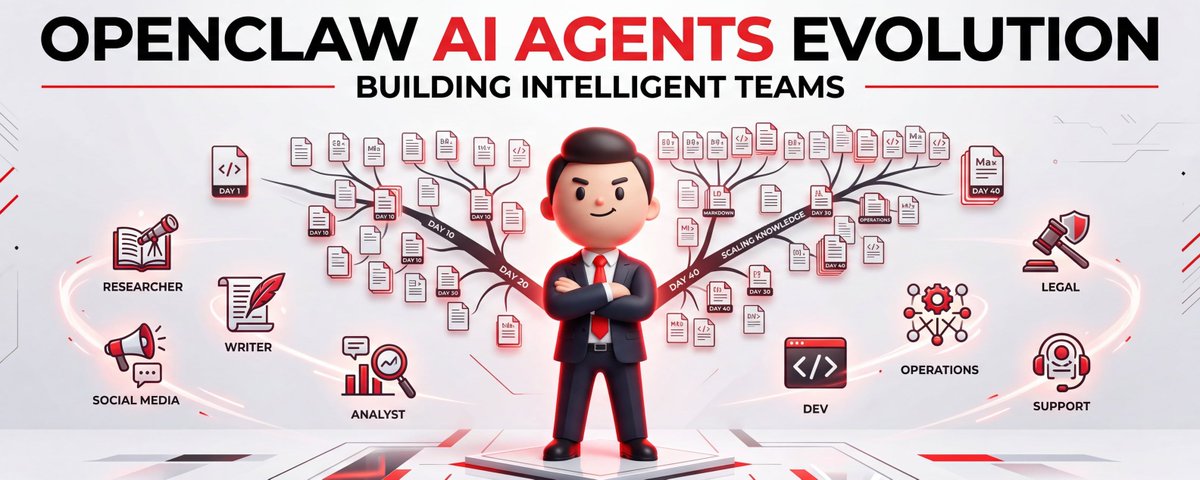
Editor’s Brief
A 40-day longitudinal study on building an autonomous agent system using OpenClaw, shifting the focus from prompt engineering to a structured, file-based "context architecture." The methodology rejects complex databases and orchestration frameworks in favor of a transparent three-layer Markdown system (Identity, Operation, Knowledge) that evolves through daily human feedback.
Key Takeaways
- Context as the Moat:** The core thesis is that agents do not inherently improve; rather, the surrounding file system becomes more precise. Success is measured by the richness of the Markdown files, not the underlying model.
- The Three-Layer Architecture:** A structured hierarchy consisting of the Identity Layer (SOUL.md, USER.md), the Operation Layer (AGENTS.md, HEARTBEAT.md), and the Knowledge Layer (MEMORY.md, shared-context).
- File-Based Integration:** Instead of APIs or message queues, agents collaborate via a shared file system using a "single-writer, multiple-reader" protocol to prevent coordination conflicts.
- Distilled Memory:** Long-term memory is managed by manually refining raw daily logs into a permanent MEMORY.md file, specifically documenting "lessons learned" and "errors to avoid."
- Self-Healing Mechanisms:** Implementation of a HEARTBEAT.md file to monitor infrastructure health, such as browser status and task scheduler execution, moving beyond simple task completion to system reliability.
Introduction
The following content has been compiled by NOVSITA using publicly available information from X/social media and is intended solely for reading and research purposes.
Key Points
- Disclaimer: This article originates from the master 𝕏@Shubham Saboo. I have organized and translated it into Chinese—feel free to follow him!
- The only thing I did was talk to them.
Note
For any sections that involve rules, earnings, or judgments, please refer to Berryxia.AI’s original wording and the most recent official information.
Editor’s Comment
This article, titled “X Import: Berryxia.AI – The OpenClaw Development Journey, Starting from Zero! Must‑Read After Installation (40 Days of Practical Experience + Character Prompt Tips)”, originates from the X social platform and is authored by Berryxia.AI. In terms of completeness, the original text delivers a high density of key information, especially regarding core conclusions and actionable recommendations.
Note: This piece is from the renowned X user @Shubham Saboo; I’ve compiled and translated it into Chinese for you. Feel free to follow along!
All I did was talk to them.
I didn’t tweak prompts, switch models, or rebuild architectures. I simply conversed, provided feedback, and watched as they recorded the content.
Forty days ago, my content‑intelligence agent was still posting tweets full of emojis and hashtags, drowning valuable information in noise. The time I spent correcting errors exceeded the time I’d spent creating the content myself.
Today, Kelly… (the sentence is incomplete in the original). For readers, the most immediate value isn’t “learning a new perspective” but quickly seeing the conditions, boundaries, and potential costs behind that perspective.
If we break this content into verifiable judgments, it would at least cover the following layers:
- Note: This piece is from the renowned X user @Shubham Saboo; I’ve compiled and translated it into Chinese for you. Feel free to follow along!
- All I did was talk to them…
Among these judgments, the conclusion section is often the easiest to spread, but what truly determines its practicality is whether the underlying assumptions hold, whether the sample size is sufficient, and whether the time window aligns. We recommend that readers, when citing such information, first verify the data source, publication date, and whether there are platform‑environment differences.
Avoid mistaking “scenario‑based experience” for a universal rule.
From an industry‑impact standpoint, this type of content usually offers short‑term guidance on product strategy, operational cadence, and resource allocation—especially in areas such as AI, development tools, growth, and commercialization.
As editors, we focus on whether it can withstand subsequent factual scrutiny:
1. Can the results be reproduced?
2. Can the methods be transferred?
3. Are the costs sustainable?
The source is x.com; readers should treat it as one input among many in their decision‑making process, not the sole basis.
Practical advice: if you plan to act on it, start with a small‑scale test, then scale up gradually based on feedback. If the original text touches on revenue, policy, compliance, or platform rules, rely on the latest official announcements and keep a rollback plan.
Reposting serves to improve information flow, but the true value of the content is realized through secondary judgment and localized practice. Guided by this principle, the accompanying editorial commentary will continue to emphasize verifiability, boundary awareness, and risk control, helping you turn “information you see” into “actionable insight.”
We need to translate Chinese parts. Let’s translate each paragraph.
Paragraph 1: “申明:本文来自𝕏@Shubham Saboo 大神,我整理翻译中文!大家可以关注一波!”
Translation: “Disclaimer: This article comes from the great Shubham Saboo on X (@Shubham Saboo). I have organized and translated it into Chinese! Everyone can follow along!”
But we need to keep meaning. “申明” is “Statement” or “Disclaimer”. “大神” is “great master” or “expert”. “一波” is colloquial meaning “a bit” or “give it a follow”. So: “Disclaimer: This article is from the great Shubham Saboo on X (@Shubham Saboo). I’ve organized and translated it into Chinese! Feel free to check it out!”
Paragraph 2: “我唯一做的事,就是跟它们说话。”
Translation: “All I do is talk to them.”
Paragraph 3: “不是调prompt,不是换模型,不是重构架构。就是说话,给反馈,看着它们把内容记下来。”
Translation: “I don’t tweak prompts, change models, or redesign architectures. I just talk, give feedback, and watch them record the content.”
Paragraph 4: figure caption: “正文配图 1” -> “Illustration 1” or “Figure 1”.
Paragraph 5: “申明:本文出自 海外大神 Shubham Saboo ,可以关注一波!x:https://x.com/Saboo_Shubham_“
Translation: “Disclaimer: This article comes from the overseas expert Shubham Saboo. Feel free to follow! x: https://x.com/Saboo_Shubham_”
Paragraph 6: “40天前,我的内容智能体写推文还堆表情包和hashtag,研究智能体把有价值的信息淹没在噪音里。我花在纠错上的时间,比自己直接做还多。”
Translation: “
am, take a look at the draft and grab a cup of coffee.
The same model is used on day 1 and day 40. The difference lies in a stack of Markdown files that grow richer every week.
That’s the file system in question.
First, let’s clear up one thing:
The agent doesn’t get smarter just because you use it longer. What becomes richer, more precise, and more tailored to your needs are the files around it. It’s that accumulated context that
**Image 3 – Main Text Illustration**
The entire operating system is built from three layers:
Figure 1 – Three‑Layer File Architecture
Each layer tackles a core question:
| Layer | Core Question | Key Files |
|——-|—————|———–|
| Identity | Who is it? Who does it serve? | `SOUL.md`, `IDENTITY.md`, `USER.md` |
| Operation | How does it work? How does it self‑heal? | `AGENTS.md`, `HEARTBEAT.md` |
| Knowledge | What has it learned? | `MEMORY.md`, daily logs, shared context |
—
Layer 1: Identity
`SOUL.md` – Who is the agent?
Image 4
This is the agent’s “personality file.” It defines the agent’s identity, responsibilities, and behavioral patterns.
Example: a research agent named Dwight
“`
SOUL.md (Dwight)
IDENTITY.m…
“`
(The text is truncated here.)
Quick Reference Card d
- SOUL.md is the agent’s full personality.
- IDENTITY.md is its business card.
—
IDENTITY.md
The file is tiny, but when you run eight agents at once, this design dramatically improves the experience. It’s also what the agent shows
体继承的根级AGENTS.md:
AGENTS.md
智能体在会话之间没有记忆,每次都从零开始。如果一个纠正没有落入文件,下次会话它就不存在了。AGENTS.md明确了这一点,确保智能体把一切都写下来。
每个智能体可以在此基础上扩展自己的规则。Kelly的AGENTS.md就添加了6个额外文件:写作风格指南、帖子格式参考、真实案例、每日任务……
HEARTBEAT.md —— 自愈机制
智能体团队是基础设施,基础设施会出故障。
Monica的HEARTBEAT.md监控两件事:
- 浏览器是否存活 — Dwight的情报扫描依赖它
- 定时任务是否执行 — 如果漏跑,Kelly和Rachel就会基于过时情报工作
第三周我就被坑过。调度器有个bug,任务在队列里推进,但从未真正执行。我好几个小时都没发现。之后我才建了心跳机制,把故障模式纳入监控。
第一天不需要这个,在你第一次遇到故障之后再建。你会清楚地知道该监控什么,因为你已经亲身感受过什么会崩。
第三层:知识层
这是真正有效的记忆系统——基于文件的三级体系。
Level 1: MEMORY.md (Essence Long‑Term Memory)
This is not a raw log, nor every event that has occurred; it contains only the truly important material.
Which blanks. Dwight reads it to set research priorities, Kelly reads it to align with my thinking. Every agent is aligned to the same source of truth.
Runs at 8 a.m. and 4 p.m.; Kelly and Rachel run at 5 p.m. Dwight goes first because everyone relies on his output. If the order is wrong, downstream agents will read stale or empty files.
Full directory structure
Why this method works
Files aren’t static—they evolve.
(Figure 8 in the main text)
Kelly’s SOUL.md was just a rough draft on day 1. By day 40 it already contained concrete tone examples, a list of rejection patterns she’d written herself, and a “never suggest again” section.
Dwight’s principle on day 1 was “find trending topics.” By day 10 it had become “if Alex can’t act on it today, skip.” On day 20 he added a verification step.
The shared‑context layer didn’t exist until day 20. At that point I was repeating the same corrections across multiple agents. Later I created THESIS.md and FEEDBACK‑LOG.md, and suddenly a single correction could propagate everywhere.
The model on day 1 and day 40 is the same. It doesn’t get smarter just because you use it longer.
However, the surrounding documentation becomes richer, more precise, and more tailored to your specific needs.
These accumulated contexts are the moat. No one can replicate it by using the same model.
You’ll need to win it by appearing every day and conversing with the agent.
How to get started (don’t try to build it over a weekend)

不是调prompt,不是换模型,不是重构架构。
就是说话。给反馈。看着它们把内容记下来。
然后有一天你打开Telegram,看看草稿,喝杯咖啡。
你的智能体已经学会了怎么帮你工作。
参考:Shubham Saboo《How to Build OpenClaw Agents That Actually Evolve Over Time》
o_Shubham_/status/2027463195150131572
Translation compiled by: Berryxia.ai
Contact: 358848136
Source
Author: Berryxia.AI
Published: March 3, 2026 11:08
Source: Original post link
Editorial Comment
The current obsession with "prompt engineering" often feels like trying to find the perfect magic spell to cast on a black box. We spend hours tweaking adjectives and system instructions, hoping for a breakthrough that rarely survives the next model update. The OpenClaw development diary shared by Berryxia.AI (and originally conceptualized by Shubham Saboo) offers a refreshing, almost industrial alternative: stop treating AI like a genie and start treating it like a junior employee who needs a comprehensive operations manual.
The most striking aspect of this 40-day journey is the total rejection of complexity. In an era where every new AI startup tries to sell a proprietary vector database or a convoluted "agentic orchestration" platform, this approach uses the simplest technology available—Markdown files on a disk. By using the file system as the integration layer, the user gains something that most AI systems lack: total transparency. You don't need to query a database to see what your agent "knows"; you just open `MEMORY.md`.
This "Context Architecture" shifts the labor from the technical to the editorial. The author notes that the model used on Day 1 was identical to the one on Day 40. The performance leap—from an agent that spams hashtags to one that mirrors the user’s specific narrative voice—came entirely from the accumulation of written feedback. This is a crucial distinction for anyone working in AI implementation. We often mistake model capabilities for system utility. Utility is built through the "blood and sweat" of daily corrections, documenting failures, and refining the `SOUL.md` file until the agent’s persona is indistinguishable from the user’s intent.
The "Identity Layer" described here is particularly nuanced. Most users give their agents a name and a job title. This system goes further, creating a `USER.md` that includes time zones, dietary preferences, and communication styles. It’s a recognition that for an agent to be truly useful, it doesn't just need to know its job; it needs to know its boss. If an agent suggests a steakhouse to a vegetarian user because it wasn't documented in the "context moat," the system has failed, regardless of how "smart" the underlying LLM is.
However, from a senior editor's perspective, there is a clear boundary to this approach: scalability. A file-based system with a "single-writer" rule works beautifully for a solo entrepreneur or a small team running a handful of agents. But as the volume of data grows, Markdown files can become unwieldy. The author even mentions having to compress logs from 161,000 tokens down to 40,000 to prevent context window bloat. This suggests that while the "file-first" philosophy is superior for quality and control, it requires a disciplined human editor to prune the "knowledge" regularly.
The real takeaway here isn't about a specific tool or a piece of code. It’s about the shift in mindset from "using AI" to "managing AI." The 40-day timeline is a realistic warning to those looking for a "plug-and-play" solution. True automation isn't bought; it’s earned through a feedback loop where the human remains the ultimate curator of the agent's memory. If you want an agent that actually works, stop looking for a better prompt and start writing a better handbook. The "moat" isn't the software—it's the 40 days of documented experience you've fed into it.