
Editor’s Brief
The explosion of AI terminology is creating a new wave of "technical inflation" that mirrors the empty corporate jargon of the past decade. By shifting focus from buzzword-chasing to demand-driven utility, professionals can bypass the psychological burden of "AI anxiety" and treat these tools as the mundane utilities they will eventually become.
Key Takeaways
- The parallel between current AI terminology (Agents, MCP, Workflows) and legacy "Big Tech" jargon used to gatekeep and overcomplicate simple concepts.
- Addressing the "2026" chronological anomaly in the source text as a symptom of the chaotic, high-pressure information environment surrounding AI.
- The "Demand-Driven" learning model: Skills are best acquired through solving immediate, real-world problems rather than theoretical tool-hoarding.
- The inevitable "invisibility" of AI: Predicting a future where AI shifts from a disruptive novelty to a background productivity standard, much like the mouse or the internet.
Introduction
Under the AI wave, even Elon Musk
Editing comments in today’s tech circles feels almost impossible without tossing out a few acronyms like MCP, Agent, or Workflow. In a recent post on X, Ma Shitu hit a nerve that’s both subtle and widespread: are we really learning AI, or are we being bullied by the “black‑talk” that the AI community has just invented? He mentions Elon Musk replying to Naval in 2026—a clear typo in the timeline or a tongue‑in‑cheek prophecy, since we’re still living in 2024. Setting that aside, Naval’s remark that “everyone will soon feel AI anxiety” accurately captures the current social psyche. That anxiety is essentially “tech inflation.” Just as Ma contrasted how old‑school tech giants once wrapped simple business logic in buzzwords like “enablement,” “closed loop,” and “deepening,” the AI scene is going through the same process. Calling a simple automation script an “intelligent agent,” or labeling a conversational prompt as “prompt‑engineering,” piles on jargon that, beyond letting course‑selling influencers charge extra, does little to help ordinary users solve real problems.
From an industry perspective, this kind of “black‑talk” is a typical chaos that surfaces in the early stages of technology diffusion. Vendors, eager to differentiate, invent new terms; developers, wanting to appear professional, keep layering on architecture. The result is a bizarre reality: technology evolves so fast that it feels overwhelming, yet the tools that actually make it into everyday workflows remain the same few. On social media, people are frantically sharing lists of “50 must‑see” items…
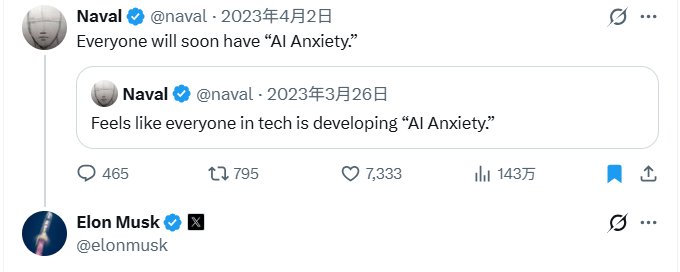
Naval once posted a tweet on April 2, 2023:
Everyone will soon have “AI Anxiety.”
Shortly thereafter, the phrase “AI anxiety” began
Here are a few examples:
- Agent, sub‑agent, prompt, context, memory, pattern, permission, tool, plugin, skill, hook, MCP, LSP, slash command, workflow, IDE integration…
- And just recently, there’s a new “lobster” called OpenClaw 🦞 that’s blowing up.
Do you remember the “industry jargon” of the big tech companies back in the day?
- Leverage, closed loop, enablement, matrix, playbook, implementation, alignment, synchronization, granularity, user experience, mindset, breakout, deepening, sync, focus, review, distillation, output, iteration, follow‑up, push, safety net, penetration, priority, resource allocation, rights and responsibilities, upward management, deliver results, metrics, transparency, middle platform, front‑end, back‑end, GMV, DAU, MAU, penetration rate, conversion, link, leverage point, incremental, existing, ROI, abstraction, pragmatism, consensus, collision, integration, optimization, graduation, fresh water, flattening, wolf‑like…
I used to feel a strong AI anxiety, chasing every new AI headline and cutting‑edge technology.
But I realized that anxiety is pointless, and many of those trendy buzzwords are just hype.
For a technology to become mainstream and reach more people, its concepts and usage can’t be overly complicated.
It needs to be simple and easy to grasp—just like when computers and the internet first became popular, the entry barrier was essentially just typing and using a mouse, plus knowing the basic functions of a few menus and icons.
Professional programmers may need to understand all the AI concepts listed above.
For ordinary users, the key is to apply them in everyday work and life scenarios.
Demand is the mother of learning. When it comes to acquiring new skills,
It really depends on whether you have a pressing need. If you do, you’ll pick it up quickly. If you can’t create a real‑world scenario that requires it, learning will feel much harder.
For most people, the anxiety of chasing the newest tools and the latest information isn’t necessary. Just learn what you need, and tie it to your own life and work situations.
Today’s AI concepts and tools are especially relevant for programmers, who have many urgent use cases. Ordinary folks have fewer of those. AI is useful, and I use a variety of its features, but I only learn and apply them when I need to.
I used to feel a strong anxiety about AI, but that’s gone now.
Do you experience anxiety when learning AI? Feel free to leave a comment and share your thoughts!
#AIAnxiety
Source
Author: Ma Shitu
Publication time: March 7, 2026 20:14
Source: Original post link
Editorial Comment
If you spend enough time on tech Twitter or LinkedIn, you’ll notice that the barrier to entry for "serious" conversation has shifted. It’s no longer enough to say you’re using a computer to help with work; you have to be orchestrating "Agents," managing "MCP servers," and optimizing "Workflows." Ma Shitu’s recent reflections on X (formerly Twitter) strike a chord because they expose a cynical truth: the AI industry is currently suffering from a massive bout of "jargon inflation."
The source text makes a brilliant, if biting, comparison between today’s AI buzzwords and the "corporate speak" that defined the 2010s. Remember when we didn’t just finish a project, we "closed the loop"? When we didn’t help a colleague, we "empowered" them? That linguistic bloat served two purposes: it made simple tasks sound expensive and it made outsiders feel inadequate. We are seeing the exact same playbook in the AI space. Calling a basic automated script an "AI Agent" doesn't change the underlying logic, but it does allow someone to sell a $500 course on it.
There is a curious detail in the source material—a reference to Elon Musk replying to a Naval Ravikant tweet in February 2026. Given that we are currently in 2024, this is either a deliberate piece of "future-dated" satire or a simple clerical error by the author. Regardless of the timeline glitch, the sentiment remains grounded in our current reality: "AI Anxiety" is the defining neurosis of the modern professional. When Nvidia’s Jensen Huang says that AI won’t replace people, but people who use AI will replace those who don’t, he’s technically correct, but he’s also fueling a FOMO-driven panic that leads to "tool-hoarding."
As a technology editor, I see this manifest as a frantic need to "learn everything." People are bookmarking "Top 50 AI Tools" threads like they’re collecting survival rations for an apocalypse. But as Ma Shitu points out, this is a recipe for burnout, not proficiency. The most effective way to learn any technology has always been demand-driven. You don’t learn how to use a spreadsheet by reading the manual from cover to cover; you learn it because you have a budget to balance and a deadline in three hours.
The current "black speech" of AI—the MCPs, the hooks, the prompt engineering—is largely a byproduct of a technology in its awkward teenage years. It’s still visible, clunky, and loud. However, the history of personal computing tells us exactly where this ends. We don't talk about "GUI navigation" anymore; we just click an icon. We don't brag about "TCP/IP utilization"; we just check our email.
The goal for any professional right now shouldn't be to master the vocabulary of the developers, but to find the one "boring" task in their daily routine that a machine can handle. If you can use a tool to save thirty minutes on a Friday afternoon, you have "learned AI" more effectively than someone who can define "latent space" but has no practical output to show for it.
The cure for AI anxiety is a healthy dose of utilitarianism. Stop trying to keep up with the "OpenClaws" of the week unless your specific job requires it. The most sophisticated users of technology are often the ones who talk about it the least—they’re too busy using it to solve problems. Eventually, these tools will "fade into the dust," becoming as unremarkable as the keyboard you’re typing on. Until then, ignore the jargon, ignore the hype-men, and just solve the problem in front of you.